Helping you get a headstart on homeownership

Tracy Head Mortgage Broker

BOOK A CALL
Let us help you find the best mortgage solution for your needs!

Tracy Head

Serving clients in Alberta & BC from my office in the Okanagan.

I love to help my clients achieve their dreams! My goal is to create client delight - to help make the process a smooth one, so my clients can focus on the things that matter most.


With over 10 years of experience as a mortgage broker and having bought and sold multiple homes myself, I understand the challenges and frustrations that come along with buying or refinancing a home.


Let me save you time and money by doing the research and walking you through the entire mortgage process.

GET STARTED

Mortgage financing can be confusing, it doesn't have to be when you follow my plan.

Get started right away

The best place to start is to connect with me directly. The mortgage process is personal. My commitment is to listen to all your needs, assess your financial situation, and provide you with a clear plan forward.

Get a clear plan

Sorting through all the different mortgage lenders, rates, terms, and features can be overwhelming. Let me cut through the noise, I'll outline the best mortgage products available, with your needs in mind.

Let me handle the details

When it comes time to arranging your mortgage, I have the experience to bring it together. I'll make sure you know exactly where you stand at all times. No surprises. I've got you covered.

Let's get started.

Choose from any of the following options!
Initial Mortgage Consultation

A quick call up front will help to get things moving forward for you. We will chat about what you are hoping to accomplish, and cover the next steps!

SCHEDULE NOW
Online mortgage application.

If you'd prefer to start the mortgage process by completing an online mortgage application, here's where we make that happen!

APPLY ONLINE
Book a call for an application

If you would like to complete your mortgage application over the phone, choose this option, we'll have time to discuss all your options!

BOOK A CALL

I'm proud to be on the Board of

Mortgage Brokers across Canada working together to make a difference in the lives of those who need it most.

LEARN MORE

You’ve worked hard your whole life. You deserve to enjoy the retirement lifestyle you've always imagined.

We specialize in mortgage financing for Older Canadians.
LEARN MORE

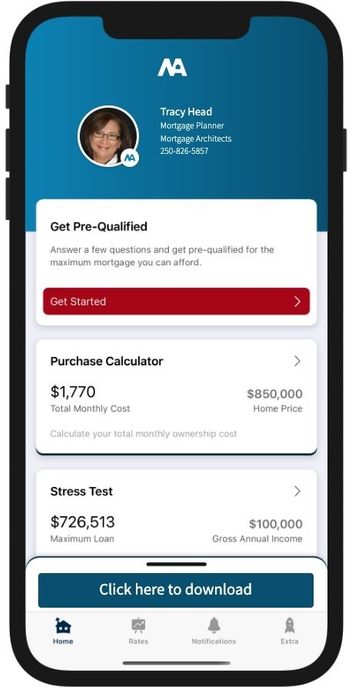
Download My Mortgage Toolbox

What can you do with my app?


Calculate your total cost of owning a home

Estimate the minimum down payment you need

Calculate Land transfer taxes and the available rebates

Calculate the maximum loan you can borrow

Stress test your mortgage

Estimate your Closing costs

Compare your options side by side

Search for the best mortgage rates

Email Summary reports (PDF)

Use my app in English, French, Spanish, Hindi and Chinese

DOWNLOAD NOW

You can keep up to date with all things mortgage related by reading my mortgage column.

By Tracy Head June 13, 2026
One of the most common misconceptions I hear from clients who are self-employed is that getting a mortgage is either impossible or requires years of perfect financial statements. Fortunately, that's simply not true. Canada's workforce has changed dramatically over the past decade. More people than ever are running their own businesses, working as contractors, driving revenue through side hustles, consulting, freelancing, or operating incorporated companies. Lenders have adapted to recognize that self-employed borrowers often have strong incomes, even if their tax returns don't tell the whole story. The key is understanding that mortgage qualification for self-employed individuals is different—not necessarily harder. Why Self-Employed Income Can Be Challenging Most traditional mortgage lenders rely heavily on income reported to the Canada Revenue Agency. The challenge is that many business owners work with accountants to legitimately reduce taxable income through business deductions and write-offs. While this strategy can lower taxes, it can also create challenges when applying for a mortgage. For example, a business owner may generate $150,000 annually but only report $80,000 in taxable income after deductions. A lender reviewing only tax returns may see a very different financial picture than the reality of the business. Fortunately, lenders have developed several solutions specifically designed for entrepreneurs and business owners. Traditional Income Verification The first option is conventional financing. Many self-employed borrowers qualify through standard programs by providing two years of Notices of Assessment, T1 Generals, business financial statements, and supporting documentation. This route typically provides access to the lowest available interest rates and is often ideal for borrowers whose reported income accurately reflects their earnings. However, when taxable income doesn't fully represent actual cash flow, alternative solutions may be more appropriate. Insured Stated Income Programs One of the most valuable tools available to self-employed Canadians is the insured stated income mortgage program. These products are available through lenders that work with mortgage insurers such as Sagen and Canada Guaranty. Under these programs, eligible self-employed borrowers can qualify based on a reasonable stated income amount that aligns with their occupation, industry, business revenues, and overall financial profile. Lenders still perform due diligence. Borrowers must demonstrate that their stated income is reasonable and supported by the business. Documents such as business licenses, GST registrations, articles of incorporation, bank statements, and proof of business activity are commonly reviewed. This program can be a game-changer for successful entrepreneurs whose tax returns don't fully reflect their true earning capacity. Generally, borrowers must have been self-employed for at least two years, maintain good credit, and provide a minimum down payment that meets insurer requirements. Business-for-Self Programs Through Alternative Lenders For some borrowers, particularly those with shorter self-employment histories or more complex income situations, alternative lenders can offer additional flexibility. These lenders often take a more holistic approach, reviewing business bank statements, retained earnings, contracts, assets, and overall financial strength rather than focusing solely on taxable income. While rates and fees may be slightly higher than traditional financing, alternative lending can provide an excellent stepping stone toward future conventional financing. The Manulife Small Business Owner Program One niche solution that has generated significant interest among self-employed Canadians is the Manulife Bank Small Business Owner Program. This program is designed specifically for incorporated business owners and can provide an alternative method of income qualification by looking beyond traditional personal income reporting. In many cases, the program considers factors such as corporate financial performance, retained earnings, and the overall health of the business. This can be particularly beneficial for incorporated entrepreneurs who intentionally leave profits within their company for growth and tax planning purposes. Programs like this recognize a reality that many business owners face: what appears on a personal tax return may not accurately represent their true financial strength. Credit Still Matters Regardless of which mortgage program is being considered, credit remains one of the most important factors. Strong credit scores demonstrate responsible financial management and can significantly improve both approval odds and financing options. Before applying for a mortgage, self-employed borrowers should ensure that payments are current, credit card balances are managed responsibly, and any errors on their credit report are addressed. Preparation Makes All the Difference The most successful self-employed mortgage applications are usually the result of preparation. Having organized financial records, current tax filings, business banking information, and supporting documentation readily available can make the approval process significantly smoother. Working with a mortgage broker can also be particularly valuable because brokers have access to a wide range of lenders, including major banks, credit unions, monoline lenders, and specialized self-employed programs that may not be available directly through a branch. The Bottom Line Being self-employed should not prevent you from achieving homeownership.  Today's mortgage marketplace offers more options than ever before for entrepreneurs, contractors, consultants, tradespeople, and small business owners. From traditional income verification to insured stated income solutions and specialized programs such as Manulife's Small Business Owner Program, there are pathways available for many different situations. If you're self-employed and considering a home purchase or refinance, don't assume the answer is no. Often, the challenge isn't qualifying for a mortgage—it's simply finding the lender and program that best understands how your business operates.
By Tracy Head May 30, 2026
When Debt Keeps You Up at Night, Your Home Equity May Offer a Way Forward As a mortgage broker, I’ve sat across the table from hundreds of Canadians carrying more stress than they let on. Sometimes it starts with a few credit cards after the holidays. Sometimes it’s a line of credit that slowly grows over time. Other times it’s unexpected life events — job loss, divorce, rising grocery bills, helping adult children, or simply trying to keep up in an increasingly expensive world. What many people don’t realize is how common this has become. There is often a quiet sense of shame attached to consumer debt. People feel embarrassed admitting they’re struggling, especially if they’ve always been financially responsible. I regularly hear clients say things like, “I never thought I’d be in this position,” or “I feel like I’ve failed.” But needing help does not mean you’ve failed. It means you’re human. One of the most effective tools available to homeowners is refinancing a mortgage to consolidate high-interest debt. By using equity in the home to pay off credit cards, personal loans, or lines of credit, many Canadians are able to dramatically lower their monthly payments and finally breathe again. The financial math is straightforward. Credit cards often carry interest rates around 20 percent or higher. Mortgage rates are typically much lower. Rolling multiple high-interest debts into one manageable mortgage payment can free up monthly cash flow and reduce financial pressure almost immediately. But the emotional impact is often even more important.  I’ve watched clients physically relax during meetings once they realize there is a realistic path forward. Instead of juggling minimum payments and watching balances barely move, they regain a sense of control. They sleep better. Relationships improve. The constant anxiety starts to ease. The key, however, is timing. Too many people wait until they are already in serious financial trouble before exploring refinancing options. They drain savings, miss payments, max out credit cards, or fall behind on bills while hoping things will somehow improve on their own. Unfortunately, once credit scores begin to drop significantly, refinancing becomes more difficult and more expensive. That’s why I encourage homeowners to have the conversation early — before missed payments happen, not after. A strong credit profile gives borrowers more options, better rates, and greater flexibility. Waiting too long can limit those choices considerably. Seeking advice early is not a sign of weakness; it’s smart financial planning. It’s also important to understand that refinancing should not be viewed as a “last resort.” In many cases, it is simply strategic debt management. Business owners do it. Professionals do it. Young families do it. Retirees do it. Millions of Canadians have used the equity in their homes to simplify their finances and regain stability. Of course, refinancing is not a magic solution. It works best when paired with honest budgeting and a commitment to avoiding the same debt cycle moving forward. But for many homeowners, it can provide the reset they desperately need. If you are losing sleep over debt, know this: you are far from alone, and there are often more options available than you think. The hardest part is usually making the first phone call.
By Tracy Head May 16, 2026
There’s a moment I see all the time in this business. A buyer walks into an open house “just to look,” falls completely in love with the place, and by supper time they’re talking about writing an offer. It’s exciting. It’s emotional. And sometimes, it’s exactly where people get themselves into trouble. I can tell you one of the smartest things a buyer can do before house hunting is get a proper mortgage pre-approval in place. Not the casual “I think we qualify for around this amount” conversation. I mean an actual reviewed pre-approval with income, down payment, credit, and monthly budget all looked at carefully. Because once you’re standing in someone else’s dream kitchen imagining where your coffee maker will go, logic has a funny way of leaving the building. A pre-approval does a few very important things. First, it tells you what a lender is likely willing to lend you. That sounds obvious, but many buyers are shocked to discover that what they want to spend and what the bank is comfortable approving are two very different numbers. Second, it helps you shop with confidence. In competitive markets, sellers take pre-approved buyers much more seriously. A seller who has two similar offers in front of them will almost always feel more comfortable with the buyer who already has financing lined up. But here’s the part I think matters even more — a pre-approval gives you the chance to figure out what home ownership will actually feel like every month. And this is where many people make a mistake. They focus only on the mortgage payment. The mortgage payment is important, of course, but it’s only one piece of the puzzle. Before writing an offer, buyers should sit down and calculate the total monthly cost of the home. That means including: Mortgage payment Property taxes City utilities Home insurance Strata fees, if applicable Heating costs Potential maintenance expenses Because the difference between “technically approved” and “comfortably affordable” can be huge. Let’s use a simple example. Suppose you purchase a home for $650,000 with a reasonable down payment. At current interest rates, your mortgage payment might land somewhere around $3,100 per month. At first glance, that may seem manageable. But then we add: Property taxes: $350/month Utilities: $200/month Home insurance: $140/month Strata fees: $450/month Suddenly the true monthly housing cost is closer to $4,240 per month. That’s a very different conversation. And if you haven’t done those calculations ahead of time, you may find yourself house-rich and lifestyle-poor after possession day. I often tell clients this: your home should support your life, not consume it. You still want room for groceries, kids’ sports, travel, retirement savings, and the occasional dinner out where nobody has to do dishes afterward. Another benefit of getting pre-approved early is discovering issues before they become emergencies. Sometimes we uncover small credit issues, missing documents, or income challenges that can be fixed with a little planning and time. It’s much better to solve those things before you fall in love with a home than three days before financing conditions are due. And please remember — just because a lender says you qualify for a certain amount does not mean you have to spend that much. Some of the happiest homeowners I know bought below their maximum approval and left themselves breathing room financially. Funny enough, those are usually the people sleeping best at night when interest rates rise or life throws a curveball. Buying a home should feel exciting, not terrifying. So before you start measuring living rooms for sectional sofas or debating paint colours, take the time to get a proper pre-approval completed and run the real monthly numbers carefully.  Future-you will be very grateful.
By Tracy Head May 4, 2026
After a couple of decades in the Canadian mortgage world, I’ve learned that the “rent vs. buy” debate isn’t really about right or wrong—it’s about timing, lifestyle, and how comfortable you are trading flexibility for long-term wealth building. Let’s walk through both sides with some real numbers, because that’s where the story gets interesting. The Case for Buying: Building Equity (and Stability) Let’s assume you purchase a home for $600,000 CAD with a 20% down payment ($120,000), leaving you with a $480,000 mortgage at a 4% interest rate , amortized over 25 years. Monthly mortgage payment: ≈ $2,530 First-year interest portion: roughly $19,000 First-year principal paydown: roughly $11,000 That principal portion is the quiet hero here. Every payment chips away at your loan and builds equity—essentially forced savings. Fast forward 5 years: You’ve paid down roughly $60,000–$70,000 in principal If the home appreciates at a modest 3% annually , your $600,000 home could be worth about $695,000 Your equity position: Original down payment: $120,000 Principal paid: ~$65,000 Appreciation: ~$95,000 Total equity: ~$280,000 That’s a meaningful wealth position built largely through time and discipline. Other advantages: Predictable housing costs (especially with a fixed rate) Protection against rising rents Freedom to renovate and personalize Leverage: you control a $600K asset with $120K down The Reality Check: The Costs of Ownership Owning isn’t just about the mortgage. On that same $600,000 home, you might also be looking at: Property taxes: $3,000–$4,000/year Maintenance: ~1% annually (~$6,000) Insurance: $1,500–$2,000/year So your true monthly cost isn’t $2,530—it’s closer to $3,200–$3,500 when everything’s factored in. And unlike rent, surprises are your responsibility. Roof leaks don’t call the landlord—they call your bank account. The Case for Renting: Flexibility and Liquidity Let’s say a comparable home rents for $2,500/month . Right away, you’re saving: ~$700–$1,000/month compared to owning (after ownership costs) Now here’s where renters can quietly win— if they’re disciplined . Investing the difference: If you invest $800/month at a conservative 5% annual return : After 5 years: ~$54,000 After 10 years: ~$125,000 Add to that your original $120,000 down payment (which you didn’t tie up in real estate), also invested: $120,000 at 5% over 5 years: ~$153,000 Total investment portfolio after 5 years: ~$207,000 That’s not far off the homeowner’s equity position—and it’s far more liquid. The Trade-Offs: It’s Not Just Math Here’s where the decision gets personal. Buying tends to win when: You plan to stay put for 5+ years You want stability and control You’re comfortable with maintenance and unexpected costs You value long-term wealth building through real estate Renting shines when: Your lifestyle or job requires flexibility You prefer predictable monthly costs You’re disciplined about investing savings You’re wary of market fluctuations or high entry prices A Final Thought from the Broker’s Desk I’ve seen clients build substantial wealth through homeownership—and I’ve seen others feel financially stretched because they bought too soon or too much house. On the flip side, I’ve met renters who quietly built six-figure investment portfolios… and others who simply spent the difference. The truth? Both paths can work beautifully—or poorly—depending on behaviour. If you’re buying, do it with a long-term mindset and a financial cushion.  If you’re renting, treat your savings like a mortgage payment to your future self. Either way, the goal isn’t just having a roof over your head—it’s making sure that roof supports the life you actually want to live.
By Tracy Head April 16, 2026
Why Skipping the Home Inspection Could Be the Most Expensive Shortcut You Ever Take By the time buyers reach the home purchase stage, they’ve often run an emotional marathon. You’ve found “the one,” navigated offers, and maybe even competed in a multiple-offer situation. At that point, it can feel tempting - almost logical - to waive the home inspection to strengthen your offer. As a mortgage broker who has seen the full lifecycle of homeownership—from eager purchase to unexpected financial strain - I can tell you this: skipping a home inspection is one of the riskiest decisions a buyer can make. A home inspection isn’t just a formality. It’s your one real opportunity to understand what you’re buying beyond the paint colour and staging. The Hidden Stories Behind the Walls Most homes look great on the surface. Fresh paint, modern fixtures, and carefully placed furniture can disguise a long list of underlying issues. A qualified home inspector, however, sees what most of us don’t. Some of the most common—and costly—deficiencies include: Roofing problems : Missing shingles, poor ventilation, or nearing end-of-life materials. A new roof can easily cost $10,000–$25,000. Foundation concerns : Small cracks may seem harmless, but they can indicate structural movement or water intrusion. Outdated electrical systems : Knob-and-tube wiring or aluminum wiring can present both safety hazards and insurance challenges. Plumbing issues : Poly-B piping, slow leaks, or poor drainage can lead to significant water damage over time. Furnace and HVAC wear : A furnace on its last legs might work fine during a showing—but fail in the middle of January. Attic insulation and ventilation : Poor airflow can lead to mold growth or ice damming—issues many buyers never think to check. And then there are the less obvious findings: Improperly installed renovations (that “beautiful” basement suite may not meet code) Grading issues around the home leading to water pooling near the foundation Bathroom fans venting into the attic instead of outside (a mold recipe) Decks or railings that aren’t structurally sound These aren’t just inconveniences—they’re financial commitments waiting to happen. The Domino Effect of Skipping the Inspection What many buyers don’t realize is how quickly these issues can snowball. A small leak becomes mold.  An aging furnace becomes an emergency replacement. A minor foundation crack becomes a major repair. And unlike cosmetic upgrades, these aren’t optional expenses. They demand attention—and often, immediate cash. From a mortgage perspective, this can put real strain on homeowners. I’ve worked with clients who stretched to purchase their home, only to face unexpected repair bills within months. It’s not just stressful - it can impact your ability to manage your mortgage comfortably. Negotiation Power You Don’t Want to Give Up A home inspection isn’t just about identifying problems - it’s a powerful negotiation tool. If issues are discovered, buyers can: Request repairs Negotiate a price reduction Or, in some cases, walk away entirely Without an inspection, you lose that leverage. You’re agreeing to purchase the home “as is” - whether you realize it or not. Peace of Mind Is Worth Something Even in cases where the inspection comes back clean, there’s real value in knowing the condition of your home. You move in with confidence, not crossed fingers. And if issues are identified but manageable, you can plan ahead - budgeting for repairs instead of being blindsided. A Final Thought In competitive markets, I understand the pressure to make your offer as appealing as possible. But there are smarter ways to do that than removing your safety net. A home is likely the largest purchase you’ll ever make. Spending a few hundred dollars on a professional inspection isn’t just wise - it’s essential. Because the truth is, what you don’t know about a home can absolutely cost you. And in this business, I’ve seen that lesson learned the hard way more times than I’d like.
By Tracy Head April 2, 2026
If you’re one of the many Canadians with a mortgage renewal coming up this year, you’ve likely felt a bit of unease reading the headlines. Interest rates, inflation, global tensions—it can feel like a lot. After more than two decades in this industry, I can tell you this: uncertainty is nothing new in real estate or lending. What matters most is how you respond to it. The good news? You have more control than you might think. Let’s walk through a few practical, level-headed strategies to help you approach your renewal with confidence—rather than stress. 1. Start Early—Earlier Than You Think One of the biggest mistakes I see homeowners make is waiting for their lender’s renewal letter to arrive. By then, you’re already on their timeline—not yours. I recommend starting the conversation at least 4–6 months before your maturity date. This gives you time to explore options, secure a rate hold if available, and avoid being rushed into a decision. 2. Don’t Just Sign the Renewal Offer It may be convenient to simply sign and send back your lender’s offer—but convenience can come at a cost. In many cases, lenders don’t present their most competitive rates in renewal letters. Think of your mortgage like any other major expense: it deserves a second look. Even a small difference in rate can translate into thousands of dollars over your next term. 3. Consider Your Risk Tolerance—Not Just the Rate In uncertain times, it’s tempting to try to “time the market.” Fixed or variable? Short term or long term? These are important questions—but they shouldn’t be driven by headlines alone. Instead, ask yourself: Do I value stability and predictable payments? Am I comfortable with some fluctuation if it means potential savings? How long do I realistically plan to stay in this home? There’s no universal “best” option—only the best fit for your comfort level and financial goals. 4. Explore Shorter Terms as a Bridge Strategy With so much unpredictability in the global landscape, some homeowners are opting for shorter-term mortgages (1–3 years) as a way to “wait and see.” This can be a smart approach if you believe rates may stabilize or improve, but it’s important to weigh this against current pricing and your tolerance for future changes. Think of it less as gambling on rates—and more as maintaining flexibility. 5. Use This Opportunity to Restructure A renewal isn’t just about accepting a new rate—it’s a chance to revisit your overall strategy. You might consider: Adjusting your amortization to improve cash flow or accelerate payoff Consolidating higher-interest debt into your mortgage Adding prepayment privileges to give yourself more flexibility This is your moment to align your mortgage with your current life—not the one you had five years ago. 6. Build a Small Buffer Into Your Budget Even if you secure a great rate, it’s wise to prepare for slightly higher payments—especially if you’re coming off a historically low rate. Creating a bit of breathing room in your monthly budget can reduce stress and give you options down the road. If rates drop, you’re ahead. If they rise, you’re prepared. 7. Lean on Professional Advice The mortgage landscape has become more complex, not less. Policies shift, lender appetites change, and new products emerge. A good mortgage broker doesn’t just shop rates—they help you interpret the landscape and make decisions that suit your long-term financial well-being. At the end of the day, uncertainty doesn’t have to mean instability. With the right preparation and a thoughtful approach, your renewal can be an opportunity—not a setback. If there’s one takeaway I’d leave you with, it’s this: stay proactive, stay informed, and don’t be afraid to ask questions. You’re not just renewing a mortgage—you’re shaping your financial future.  And that’s worth doing well.
Show More